

cosens: Remember the Story Behind the Work
Help your team find not just what happened, but why.
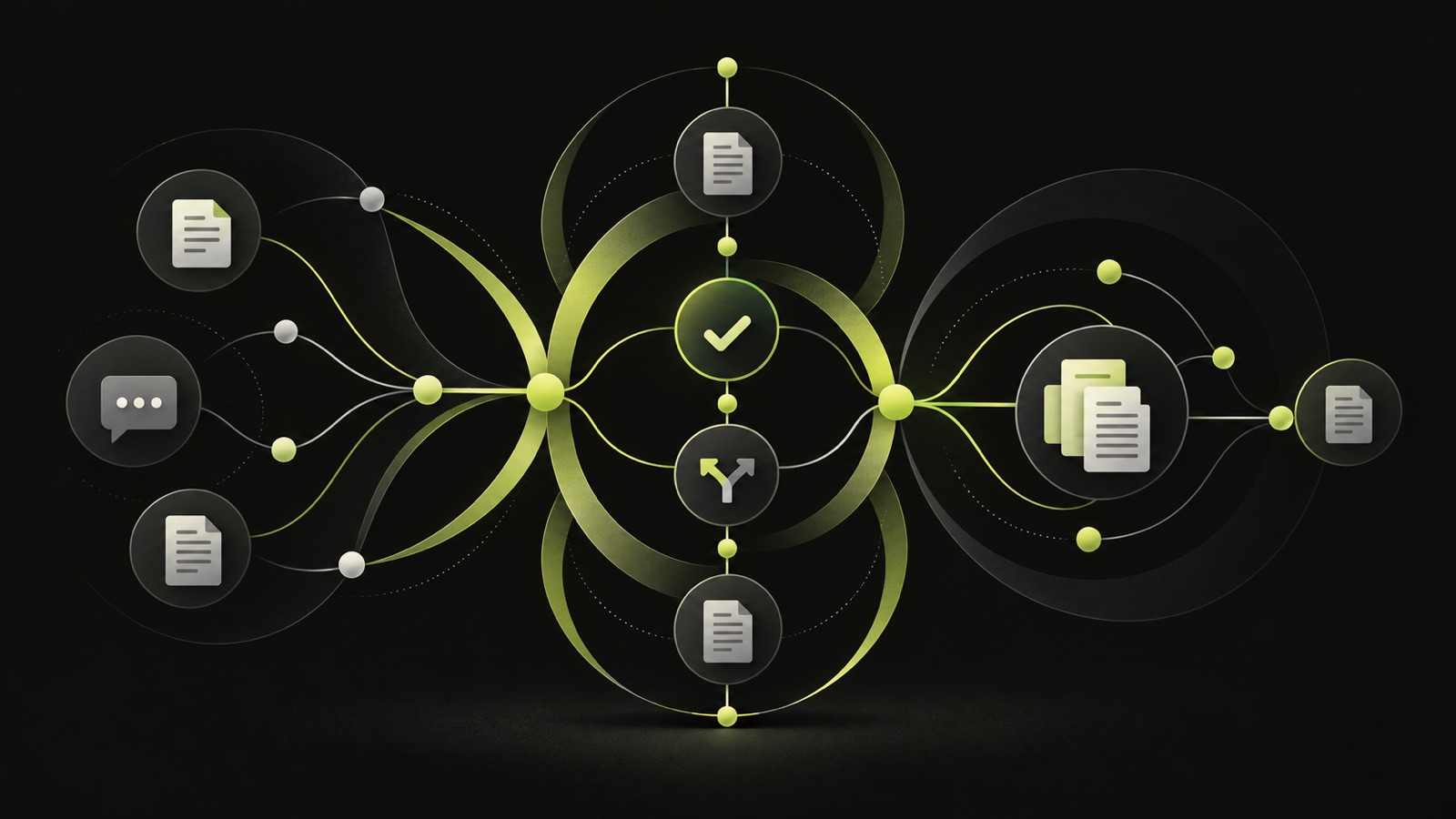
A few months ago, your team made an important decision. Now someone asks: “Why did we choose this approach? Did anything change afterward?”
The answer is probably scattered across meeting notes, emails, and team conversations. One message explains the problem. Another confirms the decision. A later discussion may describe an update—or a different project altogether.
cosens is designed to help AI bring those pieces together, so your team can understand the story behind the work.
More than a list of search results
Imagine a team launches a new shipment-tracking page. Months later, the team discusses another update to the same product. Both conversations mention the same people and product, but they are about different moments in the work.
If you ask why the original page was launched, an answer should bring together the records about that launch. And if you ask whether the original decision was later changed, the answer should look for evidence of an actual change—not assume that every later discussion changed it.
cosens is designed to help AI do that by bringing together related records, keeping useful context, and pointing back to the source material.
A clearer picture for everyday work
cosens can support questions such as:
- Project reviews: What did we decide, and what led us there?
- Customer support: What happened before, and what did the team agree to do?
- Knowledge handovers: What should a new teammate know about this decision?
The goal is to make the knowledge already captured in your team's records easier to understand and use.
What the research shows
We tested cosens alongside seven other approaches on OrgMemBench, a research benchmark that uses fictional company records to test how well AI answers questions about past work.
The table shows average scores out of 100. A score reflects how much of an answer met the evaluation criteria, including partial credit; it is not the percentage of questions answered correctly.
| Approach | Small (11 questions) | Medium (73 questions) | Overall (84 questions) |
|---|---|---|---|
| cosens | 75.40 | 63.02 | 64.64 |
| A-Mem | 55.00 | 33.24 | 36.09 |
| Hindsight | 58.48 | 36.15 | 39.07 |
| OpenViking | 47.42 | 40.16 | 41.11 |
| TencentDB Agent Memory* | 64.58 | 40.45 | 43.80 |
| Vector RAG | 50.91 | 46.33 | 46.93 |
| Mem0 | 46.44 | 38.98 | 39.95 |
| Graphiti | 35.08 | 27.20 | 28.23 |
cosens scored 64.64 overall, compared with 41.11 for OpenViking. Among the approaches tested through their native workflows with complete results, cosens had the highest overall score in this run: 23.53 points above OpenViking. Vector RAG scored 46.93; its comparison with cosens is descriptive because it used a different evaluation workflow.
TencentDB's results cover only the completed questions: 10 Small, 62 Medium, and 72 overall. Its scores are averages over those completed questions, so they are not directly comparable to the full-set overall scores and are excluded from the full-set ranking.
In one test question, cosens was asked about a product launch and whether its original facts had changed. It brought together the relevant launch records, explained the background, and reported that the information provided contained no correction. Its answer received 0.9667 out of 1 on that question.
These are results from one local research test, not a guarantee of performance in every workplace. The same AI model graded all answers, and each method had the same limit on the amount of evidence passed to the answering model. Their underlying processing differed.
Keep the knowledge behind the work
Teams do their best work when the reasoning behind past decisions stays accessible. cosens aims to help enterprise AI connect that reasoning with the records that support it—so the story is there when someone needs it.
Remember the context. Understand what changed. Find the evidence.